What is Broadcasting Over IP?

Broadcasting over IP leverages IP technologies to transmit audio, video, and data reliably, transforming live production workflows for broadcasters worldwide.

Broadcasting Over IP: what is it?

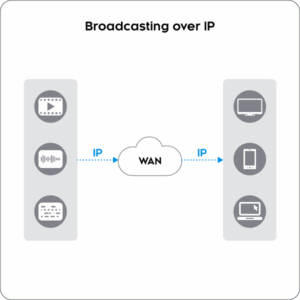
Broadcasting over IP is the use of Internet Protocol (IP) networks to transport video, audio, and associated data within and between media production environments.

In traditional broadcast infrastructures, media signals have typically been transported over dedicated connections such as SDI. Broadcasting over IP allows these signals to be carried as media flows over shared network infrastructure, making it easier to route, distribute, and reconfigure media without relying on fixed physical signal paths.

IP is now used across both local production networks (LANs) and wide-area networks (WANs), connecting studios, data centers, OB trucks, remote venues, production hubs, and cloud environments.

Standards such as SMPTE ST 2110 enable professional video, audio, and ancillary data to be transported separately over managed IP networks, providing the foundation for flexible IP-based live production.

IP in Live Production and Contribution

Broadcasting over IP can be used for different parts of the media workflow:

  • IP Production: Video, audio, and data are transported across IP networks within studios, production facilities, OB trucks, and data centers.
  • Remote and Distributed Production: IP networks connect venues with production teams and resources located elsewhere.
  • Media Contribution: High-quality media is transported between venues, broadcasters, production centers, and service providers over wide-area networks.
  • Cloud and Hybrid Production: IP connectivity enables media to move between on-premises infrastructure and private or public cloud environments.

Depending on the application and available network capacity, media can be transported uncompressed or compressed, using technologies such as SMPTE ST 2110, JPEG XS, HEVC, and other professional media transport formats.

How Nevion Supports Broadcasting Over IP

Nevion provides technologies for media transport, processing, interoperability, and orchestration across local, wide-area, and cloud-based IP environments.

  • Nevion Virtuoso is a software-defined media node for real-time media transport and processing. It supports functions such as encoding and decoding, IP adaptation, format conversion, monitoring, and protection for live production, contribution, and remote production workflows.
  • MOXELA provides software-based media processing for IP production and contribution. Its open, interoperable architecture is designed around media standards and technologies including SMPTE ST 2110, NDI, and the Media eXchange Layer (MXL), enabling software-based media applications to participate in IP workflows across on-premises and cloud environments.
  • VideoIPath provides orchestration and control of IP-based media environments, managing connectivity, media flows, devices, and processing resources across on-premises, WAN, remote, and cloud infrastructure.

Nevion solutions also support hybrid environments, enabling broadcasters to integrate existing broadcast equipment with IP-based infrastructure and migrate workflows progressively.


Benefits of Broadcasting Over IP

  • Flexibility: Media flows can be routed and reconfigured without changing physical signal paths.
  • Scalability: IP networks can support growing numbers of signals, devices, and production resources.
  • Resource Sharing: Production resources can be shared across studios, facilities, and remote locations.
  • Remote Production: High-quality media can be transported between venues and centralized or distributed production teams.
  • Interoperability: Standards-based IP technologies enable equipment and software from different vendors to work within common production environments.
  • Cloud Connectivity: IP provides the foundation for connecting on-premises production infrastructure with cloud-based processing and services.


Broadcasting Over IP vs. Traditional Broadcast Infrastructure

Traditional BroadcastBroadcasting Over IP
Dedicated signal connectionsMedia flows over shared IP networks
Physical routing determines signal pathsSoftware-controlled routing and orchestration
Resources typically tied to individual facilitiesResources can be shared across locations
Scaling often requires additional dedicated infrastructureNetwork and processing resources can be expanded more flexibly
Primarily hardware-centricSupports hardware, software-defined, and cloud-based workflows