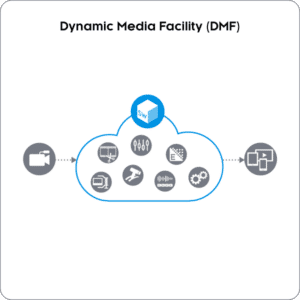
A Dynamic Media Facility (DMF) is a software-defined approach to broadcast infrastructure that replaces traditional, hardware-centric media facilities with virtualised, flexible, and programmable environments. Rather than relying on fixed routing matrices, dedicated hardware, and physically siloed systems, a DMF leverages IP networking, software-defined media processing, and cloud-ready orchestration to enable dynamic allocation of resources across live production workflows. This model allows broadcasters and media organisations to scale operations, adapt rapidly to changing production demands, and reduce dependency on proprietary hardware.
What Nevion Does
Nevion provides the foundational technology to design and operate a Dynamic Media Facility through its software-defined media solutions. VideoIPath, Nevion’s media orchestration platform, acts as the centralised control layer of a DMF, enabling dynamic provisioning, routing, and monitoring of media flows across distributed IP infrastructures. It allows operators to manage complex, multi-site production environments from a unified interface, replacing the rigidity of traditional broadcast facilities with programmable, intent-based control.
Nevion MOXELA provides cloud-native, software-based media processing for live-production and contribution workflows. Its modular media functions can run on commercial off-the-shelf servers, private cloud infrastructure or public cloud platforms. Through its native integration with VideoIPath, these processing resources can be deployed, connected, controlled and monitored as part of unified production workflows.
Together with Nevion’s professional and support services, these technologies help media organisations connect, orchestrate, transport, process and monitor production resources across distributed environments.
Benefits & Advantages of a Dynamic Media Facility
- Reduces reliance on proprietary, fixed-function broadcast hardware
- Enables rapid reconfiguration of production workflows and resources
- Supports multi-site and remote production models at scale
- Lowers total cost of ownership through software-defined infrastructure
- Improves operational agility for live events, news, and sports production
Common Questions
Is a DMF only relevant for large broadcasters?
No, the DMF model benefits organisations of any size seeking greater flexibility and efficiency in their media operations.
Does a DMF require a full infrastructure replacement?
No, it can be adopted incrementally, integrating with existing IP-based systems and evolving alongside them.
Is a Dynamic Media Facility the same as a virtualised facility?
A DMF encompasses virtualisation, but also includes software-defined orchestration, IP transport, and cloud integration as part of a broader operational model.