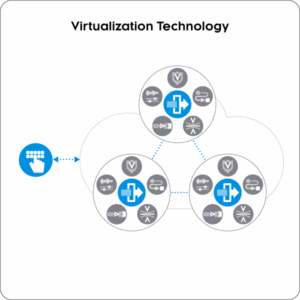
Virtualization technology separates software functions and resources from the physical infrastructure on which they run, enabling them to be deployed, shared, managed, and reconfigured more flexibly.
In traditional IT environments, virtualization is commonly associated with virtual machines, containers, servers, storage, and networks. In media production and broadcasting, the concept extends to media-processing functions and production infrastructure, helping organizations move away from fixed, dedicated resources toward more flexible and software-defined environments.
Virtualization in Media Production
Virtualization can be applied at different levels of a media production environment:
- Infrastructure Virtualization: abstracts physical production and network resources so they can be shared and managed across studios, facilities, OB trucks, remote locations, data centers, and cloud environments.
- Media Function Virtualization (MFV): separates media-processing functions from fixed-purpose devices. Functions such as encoding, decoding, IP adaptation, monitoring, and format conversion can be deployed as software-defined capabilities on a common processing platform.
- Infrastructure-Independent Media Processing: takes this concept further by decoupling media functions from dedicated media-processing hardware, enabling software-based functions to run on suitable commercial off-the-shelf (COTS) compute infrastructure and in private or public cloud environments.
These approaches allow media organizations to use infrastructure and processing resources more dynamically according to production requirements.