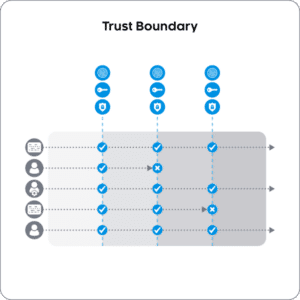
A Trust Boundary is a conceptual security perimeter within a system or network where the level of trust changes. When data, users, or services cross a trust boundary, additional security controls, such as authentication, authorization, validation, and encryption are required. Trust boundaries are fundamental in designing secure architectures, particularly in IP-based, software-defined, and distributed environments, where multiple systems and users interact across networks.
What Nevion Does
Nevion applies trust boundary principles when designing and implementing software-defined media networks. In solutions such as VideoIPath, clear trust boundaries are established between control systems, media networks, management interfaces, and external services. This approach supports secure access control, network segmentation, and protection of critical broadcast workflows in distributed production environments.
Nevion Virtuoso and eMerge also implement trust boundary mechanisms, extending these principles to media processing and orchestration layers across IP-based infrastructures.
Benefits & Advantages of Trust Boundaries
- Limits the impact of security breaches
- Supports defense-in-depth strategies
- Improves visibility and control of access paths
- Enables secure scaling of distributed systems
Common Questions
Q: Are trust boundaries physical or logical?
A: They are primarily logical but may align with physical separation.
Q: Do trust boundaries replace firewalls?
A: No, they work alongside traditional security controls.
Q: Are trust boundaries relevant to broadcast systems?
A: Yes, especially in IP contribution, remote production and cloud-based production.
Further Reading
- Media Orchestration Platform: VideoIPath | Nevion
- Broadcast Remote Production | Nevion
- Virtuoso | Nevion
- eMerge | Nevion