What Is Uncompressed Video?
Uncompressed video represents and transports video samples without applying video compression.
Because no codec-based encoding and decoding is required, uncompressed video can provide very low latency and freedom from compression artifacts, making it particularly suitable for demanding live production environments.
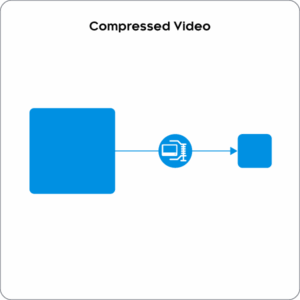
The trade-off is bandwidth. High-resolution uncompressed video requires significantly more network capacity than compressed video, particularly for UHD and higher frame-rate formats.
Modern media workflows therefore often combine both approaches:uncompressed video within high-capacity production networks and compressed video where bandwidth is more constrained, such as across wide-area networks or certain cloud connections.
What Is Uncompressed Video?
Uncompressed video represents and transports video samples without applying video compression.
Because no codec-based encoding and decoding is required, uncompressed video can provide very low latency and freedom from compression artifacts, making it particularly suitable for demanding live production environments.
The trade-off is bandwidth. High-resolution uncompressed video requires significantly more network capacity than compressed video, particularly for UHD and higher frame-rate formats.
Modern media workflows therefore often combine both approaches: uncompressed video within high-capacity production networks and compressed video where bandwidth is more constrained, such as across wide-area networks or certain cloud connections.
Compressed vs. Uncompressed Video
Choosing Between Compressed and Uncompressed Video
The appropriate approach depends primarily on:
- Bandwidth availability – compression can significantly reduce the network capacity required to transport video.
- Latency requirements – uncompressed video eliminates codec latency, while low-latency codecs can provide a compromise between bandwidth and latency.
- Image quality – different compression technologies provide different quality levels, from lossy to visually lossless or lossless.
- Processing resources – compressed workflows require encoding and decoding capabilities.
- Workflow requirements – production, contribution, remote production, cloud, and distribution environments can have very different requirements.
How Nevion Supports Compressed and Uncompressed Video
Nevion supports both compressed and uncompressed media workflows, allowing media organizations to select the approach that best meets their requirements forquality, latency, bandwidth, and infrastructure.
Nevion Virtuoso supports real-time media processing and transport for both compressed and uncompressed IP media workflows, including low-latency HEVC compression for contribution and remote production.
MOXELA provides software-based media processing on COTS compute and cloud infrastructure. It supports compressed media technologies includingHEVC/H.265 and NDI, enabling software-defined contribution and processing workflows.
Through the Media eXchange Layer (MXL), MOXELA can also participate in workflows based on the real-time, in-memory exchange of uncompressed video, audio, and metadata between software-based media applications.
Together, these technologies enable media organizations to use uncompressed media where quality and latency are priorities, and compression where bandwidth efficiency is required.
Further Information