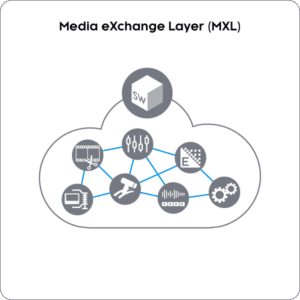
The Media eXchange Layer (MXL) is an open-source protocol developed under the Linux Foundation and the European Broadcasting Union (EBU), and supported by other organizations such as NABA, designed to enable real-time, in-memory exchange of uncompressed media and metadata between software applications running in broadcast and live production environments. Rather than routing media flows through traditional IP packet pipelines or proprietary transport layers, MXL allows software components to share video, audio, and data directly in memory, reducing latency, minimising unnecessary data copying, and improving efficiency across software-defined workflows.
MXL is a foundational element of the EBU’s Dynamic Media Facility (DMF) vision, acting as the interoperability layer that connects modular media functions and microservices within a containerised production architecture. This is precisely the layer that Nevion’s MOXELA is designed to operate within: MOXELA orchestrates and manages software-defined media functions as part of a DMF-aligned architecture, which makes MXL directly relevant to how MOXELA connects, coordinates, and scales media applications across a production environment. MXL’s open and vendor-neutral nature enables broadcasters, vendors, and technology partners to build interoperable systems without dependency on proprietary integration frameworks, an approach that mirrors MOXELA’s own role in enabling open, modular production.
What Nevion Does
Nevion supports the industry direction represented by MXL: open, interoperable and software-defined media production. Through its Networked Live portfolio, including VideoIPath and MOXELA, Nevion enables the orchestration, control and integration of media functions across IP, cloud and hybrid production environments.
This is closely aligned with the purpose of MXL, which is to make software-based media applications easier to connect and operate as part of modular production workflows. Nevion’s work on interoperability with AWS is an important example of this approach, helping broadcasters combine on-premises systems, cloud services and third-party technologies in a more flexible and operationally consistent way.
Together with Sony, Nevion is focused on enabling open, cloud-ready production architectures where software-defined media functions can be orchestrated, monitored and integrated across vendors and environments. In this context, MXL is highly relevant to the evolution of the Sony/Nevion Networked Live ecosystem, even where Sony and Nevion are not direct contributors to a specific MXL project.
Benefits & Advantages of MXL in Broadcast
- Enables vendor-neutral interoperability across software media functions
- Reduces latency by exchanging media directly in shared memory
- Simplifies integration between modular production components
- Supports scalable, cloud-native and containerised broadcast workflows
- Accelerates the transition to fully software-defined media facilities
Common Questions
Is MXL a replacement for SMPTE ST 2110?
No, MXL complements ST 2110. It is designed for efficient intra-system media exchange between software applications, while ST 2110 remains relevant for IP transport across network infrastructure.
Is MXL already production-ready?
The MXL SDK reached its first stable release in late 2025 and vendors are actively integrating it. Adoption is progressing rapidly across the industry.
Who is involved in the MXL initiative?
MXL is being developed as an open-source initiative under the Linux Foundation, in collaboration with the EBU and NABA. Broadcasters and technology vendors including the BBC, France TV, SVT, VRT, AWS, NVIDIA, Lawo and Grass Valley have been associated with the project.
Sony and Nevion’s relevance to MXL comes through their broader work on software-defined, interoperable and cloud-ready live production. Nevion’s interoperability work with AWS, together with the Sony/Nevion Networked Live ecosystem, reflects the same industry shift that MXL is designed to support: flexible media production across on-premises, cloud and hybrid environments.