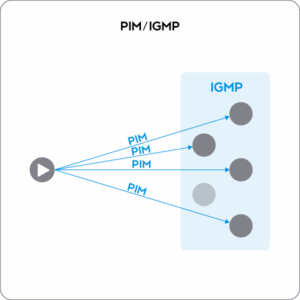
PIM and IGMP (PIM/IGMP (Protocol Independent Multicast / Internet Group Management Protocol ) are key protocols that manage multicast traffic in IP networks—IGMP controls group membership, while PIM routes the multicast streams.
Multicast is a method of efficiently delivering the same content to multiple receivers across an IP network. Instead of sending separate unicast streams to each endpoint, a single multicast stream is transmitted, and multiple receivers can subscribe to it. Two protocols make this possible:
- IGMP (Internet Group Management Protocol): Used by receivers (e.g., set-top boxes, servers, media nodes) to signal their interest in joining or leaving a multicast group.
- PIM (Protocol Independent Multicast): Used by routers and switches to establish and maintain the actual paths for delivering multicast packets across the network.
Together, IGMP and PIM are the backbone of multicast-based IP transport, ensuring that video, audio, and data can be distributed efficiently to many endpoints—crucial for broadcast contribution and distribution workflows.
What Nevion Does
Nevion supports multicast transport, including PIM and IGMP, as part of its IP contribution and distribution workflows.
- Nevion Virtuoso: Supports multicast transport of MPEG-2 TS and ST 2110 flows, integrating with IGMP for group membership and PIM for routing across IP networks.
- VideoIPath Orchestration: Provides centralized control of multicast flows, abstracting the complexity of IGMP joins and PIM routing so operators can easily manage media paths.
- Hybrid Integration: Works across legacy multicast deployments and modern SDN-controlled networks, ensuring smooth migration and interoperability.
- Resilience: Nevion solutions integrate multicast transport with SMPTE ST 2022-7 hitless switching, ensuring reliability even in case of packet loss or link failure.