What is PIM/IGMP?

PIM/IGMP

PIM (Protocol Independent Multicast) and IGMP (Internet Group Management Protocol) are essential for managing multicast traffic in IP networks. IGMP handles group membership, while PIM directs multicast routing—together enabling efficient, scalable media streaming and broadcast delivery.

PIM and IGMP (PIM/IGMP (Protocol Independent Multicast / Internet Group Management Protocol ) are key protocols that manage multicast traffic in IP networks—IGMP controls group membership, while PIM routes the multicast streams.


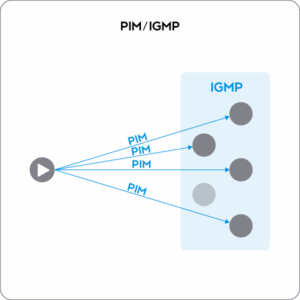
Multicast is a method of efficiently delivering the same content to multiple receivers across an IP network. Instead of sending separate unicast streams to each endpoint, a single multicast stream is transmitted, and multiple receivers can subscribe to it. Two protocols make this possible:

  • IGMP (Internet Group Management Protocol): Used by receivers (e.g., set-top boxes, servers, media nodes) to signal their interest in joining or leaving a multicast group.

  • PIM (Protocol Independent Multicast): Used by routers and switches to establish and maintain the actual paths for delivering multicast packets across the network.

Together, IGMP and PIM are the backbone of multicast-based IP transport, ensuring that video, audio, and data can be distributed efficiently to many endpoints—crucial for broadcast contribution and distribution workflows.


What Nevion Does

Nevion supports multicast transport, including PIM and IGMP, as part of its IP contribution and distribution workflows.

  • Nevion Virtuoso: Supports multicast transport of MPEG-2 TS and ST 2110 flows, integrating with IGMP for group membership and PIM for routing across IP networks.

  • VideoIPath Orchestration: Provides centralized control of multicast flows, abstracting the complexity of IGMP joins and PIM routing so operators can easily manage media paths.

  • Hybrid Integration: Works across legacy multicast deployments and modern SDN-controlled networks, ensuring smooth migration and interoperability.

  • Resilience: Nevion solutions integrate multicast transport with SMPTE ST 2022-7 hitless switching, ensuring reliability even in case of packet loss or link failure.

Benefits & Advantages of PIM/IGMP in Media Networks

  • Efficiency: Delivers one stream to many receivers without duplicating bandwidth.

  • Scalability: Ideal for large broadcast networks distributing the same content widely.

  • Flexibility: Receivers can dynamically join or leave multicast groups with IGMP.

  • Interoperability: Protocols are widely supported across IP networking equipment.

  • Cost Savings: Reduces network load compared to unicast delivery.

Comparison with Other Distribution Methods

MethodDescriptionProsCons
UnicastOne stream per receiverSimple, works everywhereBandwidth-heavy, not scalable
BroadcastOne-to-all deliverySimple, no subscription requiredInefficient; all devices receive traffic
Multicast (PIM/IGMP)One-to-many delivery, subscription-basedEfficient, scalable, widely supportedMore complex to configure/manage

Common Questions

Q: What is the role of IGMP vs. PIM?
A: IGMP is used at the receiver side to signal group membership, while PIM is used by routers/switches to route multicast packets through the network.

Q: Do broadcasters still rely on PIM/IGMP with SDN?
A: Yes. While SDN offers centralized control, many networks still use IGMP/PIM for compatibility. Platforms like VideoIPath can manage both.

Q: Can multicast work over the internet?
A: Not typically. The internet doesn’t natively support multicast at scale, so technologies like SRT or CDNs are used for wide distribution.

Q: Is multicast more secure?
A: Not inherently—security depends on network design. However, multicast does reduce exposure since streams are only delivered to subscribed devices.

Further reading