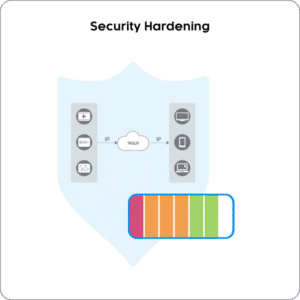
Security Hardening for Broadcast Networks is the process of strengthening broadcast and media infrastructure by reducing vulnerabilities, limiting unnecessary services, and enforcing secure configurations across devices, servers, and network components. In IP-based environments, hardening helps protect mission-critical systems such as orchestration platforms, routing infrastructure, and production control systems against cyberattacks, misconfigurations, and unauthorized access.
What Nevion Does
Nevion supports security hardening practices across software-defined media networks by applying secure-by-design principles and recommending best-practice configurations for IP-based deployments. In products such as VideoIPath, access control, secure communication, and system segmentation contribute to a hardened operational environment, helping broadcasters protect live workflows while maintaining performance and reliability.
Additionally, Nevion Virtuoso supports security hardening at the media-node and network-edge level. The Virtuoso Element Manager includes authentication and security features, and its IP Media Edge (IPME) acts as a trust boundary with network isolation, media firewall, and stream protection for RTP/IP flows. While Virtuoso secures the media processing and network-edge layer, VideoIPath strengthens the orchestration and control layer through secure control, monitoring, and access management, including features such as single sign-on (SSO). Together, Virtuoso and VideoIPath provide comprehensive security hardening across broadcast infrastructures.
Benefits & Advantages of Security Hardening for Broadcast Networks
- Reduces exposure to common cyber threats
- Minimizes attack surface across critical infrastructure
- Improves resilience of real-time production workflows
- Supports compliance with industry security frameworks
Common Questions
Q: Is hardening only for IT systems?
A: No, it applies to broadcast devices, control systems, and IP networks.
Q: Does hardening impact live production performance?
A: When properly planned, it improves stability without affecting performance.
Q: Is hardening a one-time activity?
A: No, it requires continuous updates and validation.
Further Reading