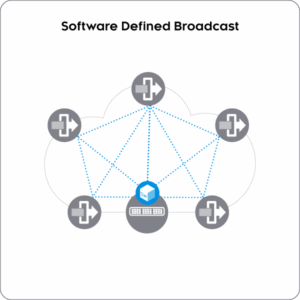
Software Defined Broadcast (SDB) is an approach to media production in which broadcast functions are implemented and managed through software, reducing dependence on dedicated, fixed-function hardware.
Traditionally, broadcast infrastructures have relied on specialized appliances for individual functions such as encoding, decoding, signal processing, conversion, and transport. With Software Defined Broadcast, these capabilities are increasingly delivered as software-defined media functions running on flexible processing platforms.
This allows media organizations to deploy, reconfigure, and update functionality according to changing production requirements. Depending on the architecture, software-defined functions can run on dedicated media platforms, commercial off-the-shelf (COTS) compute infrastructure, or in private and public cloud environments.
SDB therefore enables a transition from fixed-purpose broadcast infrastructure toward more flexible, scalable, and software-driven production environments.
What Nevion Does
Nevion applies Software Defined Broadcast principles across media processing, transport, and orchestration:
- Nevion Virtuoso: A software-defined media node that enables different real-time media functions—including encoding and decoding, IP adaptation, audio and video processing, monitoring, and transport—to be deployed on a common platform.
- MOXELA: A cloud-native, infrastructure-independent media processing platform built around modular software-based media functions that can be combined to create different live production and contribution applications. Functions can be deployed on COTS infrastructure or in private and public cloud environments, extending Software Defined Broadcast beyond dedicated media hardware.
- VideoIPath: Provides the orchestration and control layer for software-defined production environments, managing connectivity, media flows, devices, and processing resources across on-premises, WAN, remote, and cloud infrastructures.
Together, these technologies enable media organizations to decouple media functionality from fixed-purpose infrastructure and dynamically orchestrate processing and connectivity according to production needs.